
Introducing our Exploration of Ancient Mesopotamia
A primer on ancient Mesopotamia
The following issue departs from the typical essay format. It is intended to serve as primer to provide context for the subject of future essays. If you are coming to Inheritance for the first time, I recommend reading The Long Road for a more representative example of Inheritance and as the first essay in our Prehistory series.
Welcome to history! Up to this point, Inheritance has explored the origins of humanity, life in the ice age, and the first agricultural revolution. Artifacts from these formative periods allow us to make some important inferences about what our forbearers were responding to and the ways in which they overcame the challenges they faced. But, for nearly the entire span of human endeavor, there was one element missing: the human voice describing its own experience. Around 5,400 years ago in Sumer, a scribe pressed the end of a reed into a tablet of soft clay and the human voice entered the historical record.
As a result of writing, this subject matter is rather more familiar. The Epic of Gilgamesh is taught in high schools, as is the first recorded legal code: the Code of Hammurabi. You probably don’t know the names of the first gods worshipped in Sumer, but you may have heard what the Babylonian gods called them a millennia later. Marduk and Ishtar still live in the modern consciousness as the ancient and mysterious gods of an ancient and mysterious people.
Personally, I feel rather overwhelmed as I enter this era. We are now engaging with real, specific people. It would be a shame for their words to survive the vicissitudes of five millennia only to be misrepresented by me.
If I am to make an attempt at understanding the people of this era, the ways that make them distinct, and the common spark within us, if I am to appreciate how we have inherited the fruits of their labor, I need to have some understanding of the world they inhabited. Finally, I should attempt to understand this era not as an island in time and space, but as a part of the continuous human story.
To these ends, I present a primer to orient our inquiry into this era. Hopefully this will make it easier to picture the world our subjects inhabited and contextualize them within the course of history without getting bogged down in the minutia that weighs down so many history books.
NB: This primer will be edited on an ongoing basis.
What do we intend to accomplish?
As we begin our exploration into the first civilizations, we should define our own objectives and the thrust of our inquiry. As with all of Inheritance, our exploration of Mesopotamia has two components: uncovering the human spirit and understanding the incremental changes in culture and institutions that led to our modern era.
The human spirit
It is my steadfast conviction that although the incidental details of their lives differed greatly from our own, the human spirit is fundamentally the same now as it was then. If we are to see the people of this era and ourselves as engaged in fundamentally the same project rather than a disconnected fragment of history, we should try to first understand what separates us.
Time: How do we conceptualize the expanse of time separating our era from this: 5,000 years? How does anything from that era survive into our own and why are the objects that do so precious?
People: How did they live? What was the world they inhabited? How did they see themselves? Who were the specific people whose names and labors survived?
The continual project
Mesopotamia of the 4rd millennia BC is at an inflection point in the human story. Life and labor henceforth is fundamentally different from that of hunter-gatherer and earlier agricultural societies. The institutions, technologies, and challenges that shape the modern world began here.
What is Mesopotamia?
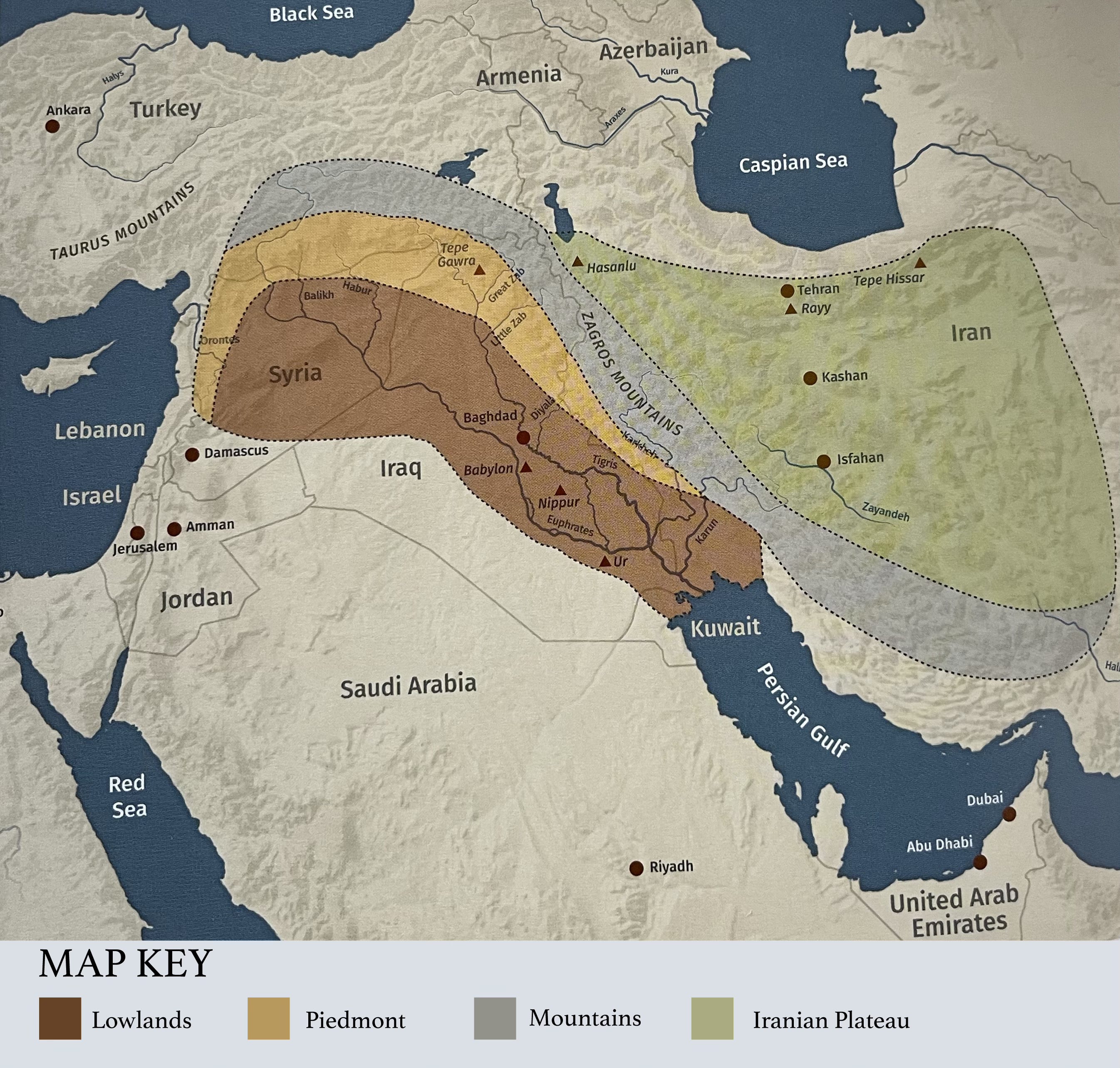
Mesopotamia is the name the ancient Greeks gave to the land between the Tigris and Euphrates rivers: “Meso” meaning “between” and “potamos” meaning “river”. This roughly corresponds to modern-day Iraq. Mesopotamia is part of the Fertile Crescent, the region of the world where agriculture was first developed and it is here where the first cities and empires took root. This region is also part of what is referred to as the “Near East” or “Middle East”. The area of immediate concern to is between Babylon to the North and the Persian Gulf to the South within the brown-shaded area in the map below.
When and where is it?
Around 8,500 BC, agriculture and permanent settlements emerge elsewhere in the Fertile Crescent. The first settlements in Mesopotamia emerge around 6,000 BC, beginning the Ubaid period. Around 4,000 BC the first city, Uruk, establishes itself as the center of cultural power. We are concerned with the period from 3,400 BC to 2,300 BC when writing, bureaucracy, and urbanization are developed, but before the first empire.
What interesting was happening here?
In the alluvial plains of Mesopotamia, history begins. People began living in cities, a radically different and more complicated way of life. This complexity led to the development of writing, accounting, and bureaucracy. It was here that humanity first encountered the problems that would shape the modern world and attempted to overcome them. The oldest names of which we have record are from here. The oldest story was written here, The Epic of Gilgamesh, which includes the “flood myth”, a version of which later appears in the Old Testament. The first legal code, that of Hammurabi, was written in stone here. The first pieces of monumental architecture were erected to honor the first gods whose names we know. The increasing demands of cities and the means to procure them led to a concentration of power and the establishment of colonies. Eventually, this would lead to the establishment of the first empire.
What was happening elsewhere in the world at this time?
In 10,000 BC, at the cusp of the advent of agriculture, the world was populated by around 1 million humans. By 4,000 BC the global population had increased to 7 million. The world was changing, but slowly. The people of Mesopotamia were the most advanced in the world but were neighbored by several of the few other people who were agricultural, rather than hunter-gatherers. Elam to the east, Assyria to the North, the Levant to the West, and Anatolia to the Northwest all had long-established agricultural communities.
China had agricultural communities nearly as old as those of the Fertile Crescent. Western Europe, Egypt, and the Indus Valley had all recently imported agricultural practices from elsewhere. Mesoamerica and a few portions of South America were just on the cusp of developing agriculture. It’s possible that there was some agriculture in the Sahel (northern Sub-saharan Africa) and New Guinea. Everywhere else in the world, people were living as they had for a hundred thousand years: living in small, nomadic bands of around 150 people, hunting and gathering for their daily meals.
What was their environment?
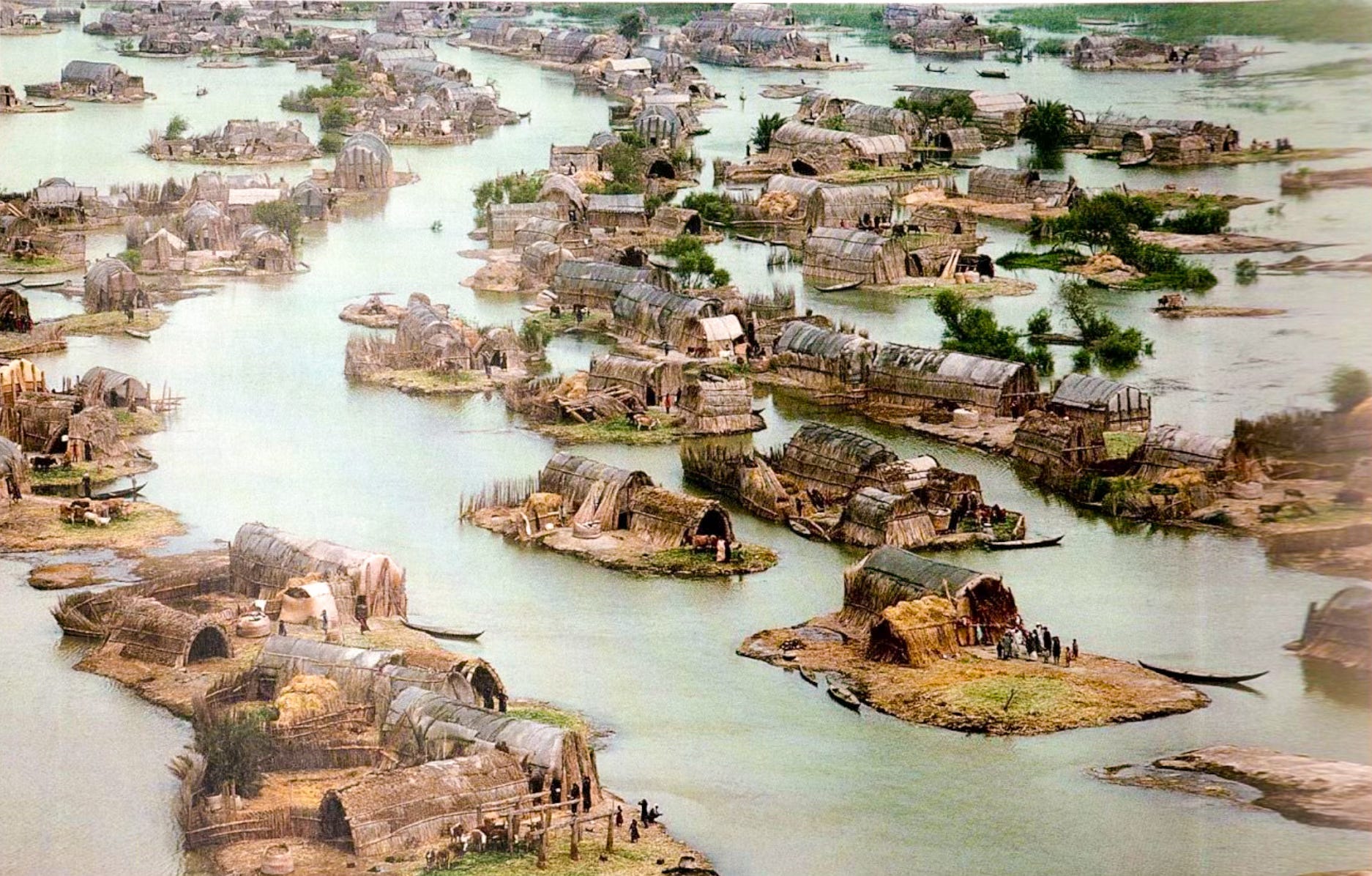
Sumer lies in the alluvial plains of Mesopotamia. The land is incredibly flat. The few trees that speckle the horizon are twisted and craggy. The earth itself is comprised of millions of years of deposits from the Tigris and Euphrates. Although the boundary between earth and heaven is stark, the boundary between earth and water is ever-shifting. The rivers don’t have rocky beds to set their courses so they shift regularly, flooding the plains. Managing this elemental chaos was the fundamental activity that gave life to civilization: the alluvium is fertile and the rivers were an abundant source of water in a region that rarely gets rain. Water, properly managed, enabled abundant crops and herds of livestock.
Southern Mesopotamia was marshy and the first cities were established on the northern periphery of these marshes. One of the first large-scale infrastructure projects was the draining of marshland to create arable land by the Ubaids in the 5th millennia BC.
Major events
3,500 BC — Uruk, established around a millennia before, attains the scale of a city with an area of around 2.5 square kilometers. A complex network of canals is established to water the fields around the city resulting in a massive and reliable source of food.
3,400 BC — Early writing system developed
3,300 BC — Early lexical texts
3,100 BC — Base-60 / sexagesimal numeral system developed.
2,900 BC — Uruk reaches it’s maximum extend
2,334 BC — Sargon of Akkad establishes the first empire.
Cities
Uruk, the first city achieved a population larger than 5th century BC Athens five millennia ago. Soon after, several other cities developed in the surrounding area. The region surrounding these cities managed to produce enough food to support an unprecedented population and manage the frustration, congestion, and tension that comes with living in a dense area. Temples acted both as centers of both worship and bureaucracy as the educated elite managed ever more complex systems of trade and monumental works. One product of this bureaucracy is the first writing system, cuneiform. Around a millennia later, bureaucracy and the concentration of power that it supported led to the first empire.
Writing
There are signs that humans have been trading for as long as we’ve been human. Although the advent of agriculture and animal husbandry added a deal to the complexity of trading relationships and resource management, keeping records by memory had been sufficient. The massive size of Uruk, and consequently some of the institutions within it began to engage in commerce on a scale that no memory was capable of capturing. Additionally, trust was no longer sufficient for all transactions: some record keeping was necessary in order to settle disputes. To address these needs, proto-cuneiform was developed within the temple bureaucracy. Scribes pressed a reed into clay to form wedge-shaped marks (hence the name).
Initially these were pictographic and represented things pertinent to accounting such as wheat, beer, quantities and such. Rather quickly, these characters became abstracted and were used to represent a wider array of things. At first these were professions and matters of temple life, but within a millennia or so, cuneiform was a fully-fledged written language and was used to create the first literature.
Continuity
Mesopotamia doesn’t quite have the cultural cache that Greece or Rome has, in part because there is a fairly straightforward line of continuity between those civilizations and our own. Successive generations of writers and philosophers found something worth revitalizing in the writing from these civilizations. In one form or another, the plays of Aeschylus and the epic poetry of Homer have been a part of each generation’s consciousness since 500 BC.
The civilizations of ancient Mesopotamia were incredibly influential, but for a variety of reasons, that didn’t quite translate into the intergenerational conversation. For a long stretch of early Mesopotamian culture, there was no one else to write about them. While Latin lived on continuously through the Catholic Church, the last document written in cuneiform dates to around 75 AD and had ceased being a language of literature long before. Cuneiform remained untranslatable until the 19th century.
While Augustus Caesar “found Rome a city of bricks and left it a city of marble”, the cities of Mesopotamia remained bricks forever. Once abandoned, mud brick buildings quickly retreat into the landscape from whence they were drawn. Though the cities of Mesopotamia were the pinnacle of civilization for millennia, they faded from memory as the desert sand piled up and the world moved on.
Nearly all of the first three millennia of civilization, a period of time roughly equivalent from now to the zenith of Ancient Greece, were lost until the 19th century. Later Mesopotamian civilizations such as Babylonia did make it into the Western canon, though not in the most flattering ways. The Babylonians were recorded as the persecutors of the Jews in the Old Testament and the Tower of Babel remains one of the most potent stories of hubris.
Preview of future essays
Mesopotamia: Adding Chapters to the Human Story: Discovering lost civilizations of Mesopotamia, adding chapters to the human story, and the chapters we risk losing forever.
The Glamour of Excavation: A look at the role of the archeologist and the thrill of discovery.
Uruk: Life in the First City: An attempt at trying to recreate life in the first city and a review of the first attempts to manage an unprecedentedly complex institution.
Trade and Early Economic Integration: Complex and organic trading systems sustained life in a hostile environment, created wealth, and enabled monumental projects. A look into what was being traded, how trade led to writing, and what we can learn from the intrepid merchants who assumed risk in order to create.
Cuneiform, the First writing System: Early spreadsheets, school exercise sheets, and the wedge-shaped writing system that carried the human experience into the historical record.
Gilgamesh: The First Epic Hero: Heretofore, every hero had been lost behind the veil of time. The story of Gilgamesh tells of his quest for immortality. In the tablets that would carry his story for millennia, he was the first to achieve it.
The Temples of Ur: A deep dive into the excavations of Ur led by Mr. C.L. Wooley, the challenges they faced, the insights they cleaned, and the treasures they unearthed.
The Dawn of Empire and Sargon of Akkad: While the city-states of early Mesopotamian civilization were able to project power and establish colonies, Sargon of Akkad established the first empire. A look into how this new institution was established and managed.
Begin at the Beginning: Prehistory and Human Origins

References
Baikie, James. The Glamour of Near East Excavation. London: Seeley, Service & Co. Ltd, 1927.
Bauer, Susan Wise. The history of the Ancient World: From the earliest accounts to the fall of Rome. New York: W.W. Norton, 2007.
Crüsemann, Nicola, and Timothy F. Potts. Uruk: First City of the ancient world. Los Angeles: The J. Paul Getty Museum, 2019.
Leick, Gwendolyn. Mesopotamia: The invention of the city. New York: Penguin, 2003.
Podany, Amanda H. The ancient near east: A very short introduction. Oxford: Oxford University Press, 2014.
Podany, Amanda H. Weavers, scribes, and kings: A new history of the ancient near east. New York, NY: Oxford University Press, 2022.
Tinney, Steve, and Karen Sonik. Journey to the city: A companion to the Middle East Galleries at the Penn Museum. Philadelphia: University of Pennsylvania Museum of Archaeology and Anthropology, 2018.
Thanks wholeheartedly. It means the world to me.
Wonderful, as always, dear Nika. You are definitely a most talented storyteller. In my next life I want to be a little Roman statuette that you can carry in your pocket when you visit museums, or that you can put somewhere overseeing your laptop when you write. I'll behave, I promise, and will look in awe as you collect so many pieces of human history, so we can forget the dark realities of nowadays and get lost in the beauty and magic of the stories of yesteryear... Thanks always for rescuing our fascinating history.